

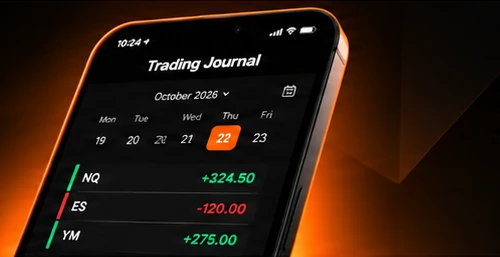

The Trading Journal
The journal is not there to tell you how much you made. It is there to tell you why, and whether it can be repeated.
By Fabian Garcia and Daniel UrbayPublished Updated 6 min read
What has to be recorded
The numbers record themselves if the journal is connected to the account: entry, exit, size, commissions, duration. That part should not cost you a minute a day.
What you do have to write is what is not in the trade: why you entered, what you expected and what happened that you did not expect. Without that, a journal is a bank statement.
The metrics that say something
The win rate on its own says nothing: you can be right 80% of the time and lose money. What matters is the relationship between what you make when you are right and what you lose when you are not.
And the streaks: the longest chain of consecutive losses and how long you took to recover. That figure determines the size you can trade without being knocked out of the game.
- Average win against average loss: the one that keeps the system alive.
- Maximum drawdown: what you have to endure without changing plan.
- Result by time of day: there is nearly always one hour that ruins you.
- Result by instrument: there is nearly always one that is not for you.
How to review it
Once a week, not every night: while it is hot you review the result, and once it is cold you review the patterns. And you look for what repeats, not for the worst trade.
The useful question is not what went wrong, but what you did differently from your plan and how many times. If it is zero, the problem is the plan; if it is many, the problem is something else.
How many accounts
People trading prop-firm accounts usually run several at once, and there a manual journal becomes impossible. In Tradelix the journal comes in with the Elite plan, with up to ten accounts, and is unlimited on Institutional.
Frequently asked questions
- Journal by hand or automatic?
- Automatic for the numbers, by hand for the reason. The first one done by hand is abandoned within two weeks; the second cannot be filled in by any program.
- How many trades are needed to draw conclusions?
- Rather more than one would like. With twenty there is nothing statistical; with two hundred patterns start to show.
- Is a journal useful if I trade rarely?
- Even more so: with few trades, each mistake weighs far more in the result.
Carry on here
Educational material. Trading leveraged futures carries a risk of loss that can exceed the capital deposited. None of the above is investment advice or a recommendation to buy or sell. Full risk disclosure.
See how this is read in Tradelix